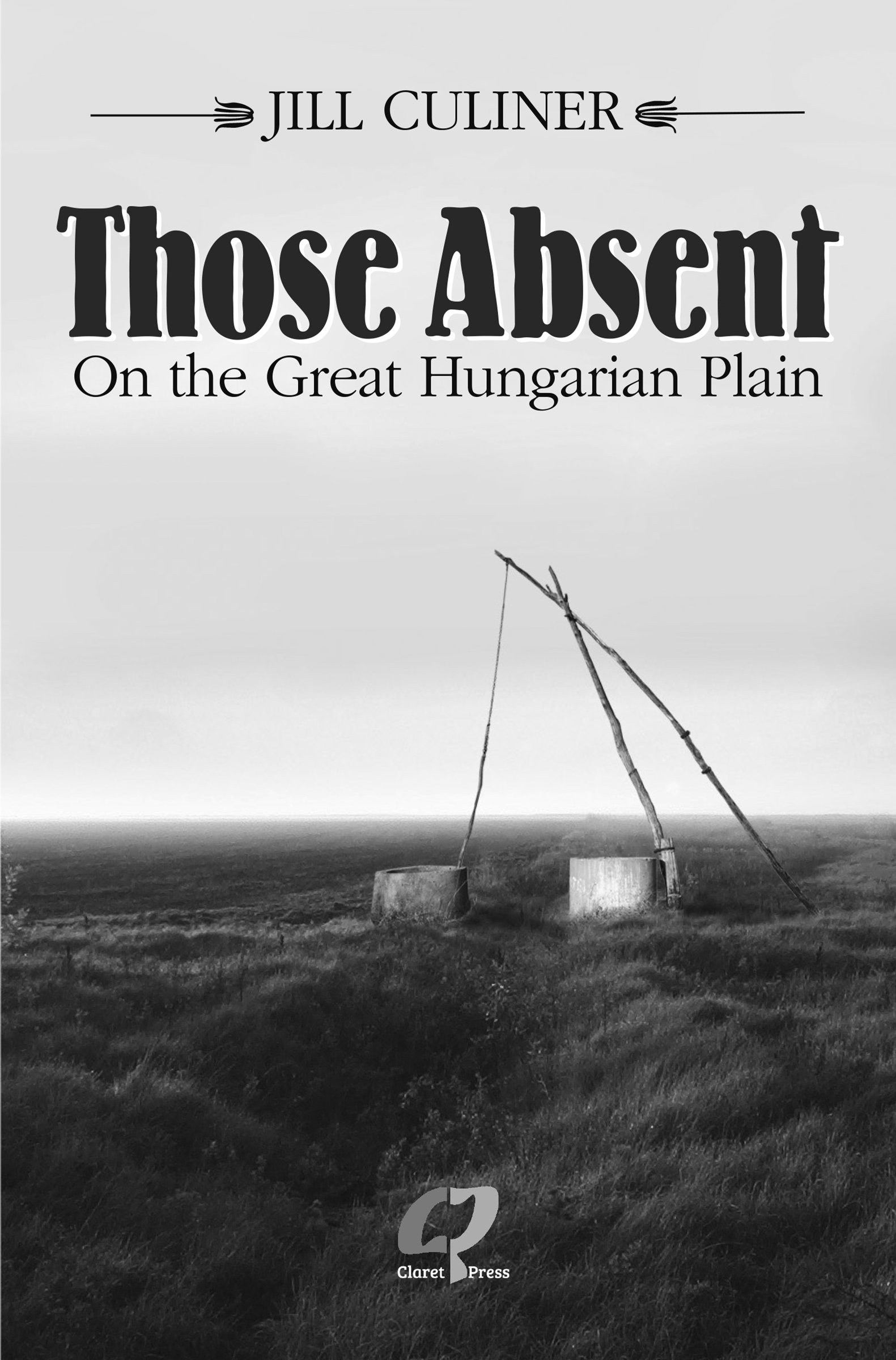
In 1999, I was in Budapest, preparing a photographic exhibition about the vanished Jews of Eastern Europe, when I heard about the Kunmadaras pogrom: In May 1946, Holocaust survivors were accused of kidnapping Christian children and using their blood for kosher sausage. Grabbing iron bars, garden tools, any weapon they could find, the town’s residents went on a rampage, murdering Jews and pillaging their homes and businesses
How could such an absurd accusation have been levelled after the war? I was determined to discover the answer.
When I arrived in Kunmadaras, I was accepted by a group of friendly locals who hung around the local watering hole run by blowsy Ildikó — Tarzan, the black marketer and corrupt night watchman, Udo, the Austrian who preferred Hungarian women to his wife, Kata, the eternal party girl, hard-drinking Karcsi, and the brutal Ibolya. And although no one seemed to resent my questioning, all denied having any knowledge of the pogrom.
Settling in the neighbouring village of Tiszaörs, I soon discovered that village society was a unique but uneasy mix of former communists, dispossessed nobles, expropriated peasants, German retirees, black marketers, former members of the Hitler Youth Movement, and Hungarians who had returned after communism ended.
I began looking for traces of the vanished local Jewish community. And I discovered that, although Jews had lived here for hundreds of years and had arrived in the country alongside the Magyar tribes in the 9th century, the villagers denied their existence. Therefore, I became more determined to question, listen, observe, to ferret out the truth about the pogrom and the Jews who were so strikingly absent.
Living on the Hungarian Great Plain was a remarkable experience, and carrying out an investigation, much as an amateur detective would, allowed me to step into the country’s history. Therefore, Those Absent on the Great Hungarian Plain is a blend of history, traditions, local happenings, rumour, love stories, and prejudices. And I hope I have portrayed, with empathy, people who, often caught in political conflicts, are pawns in a global one.
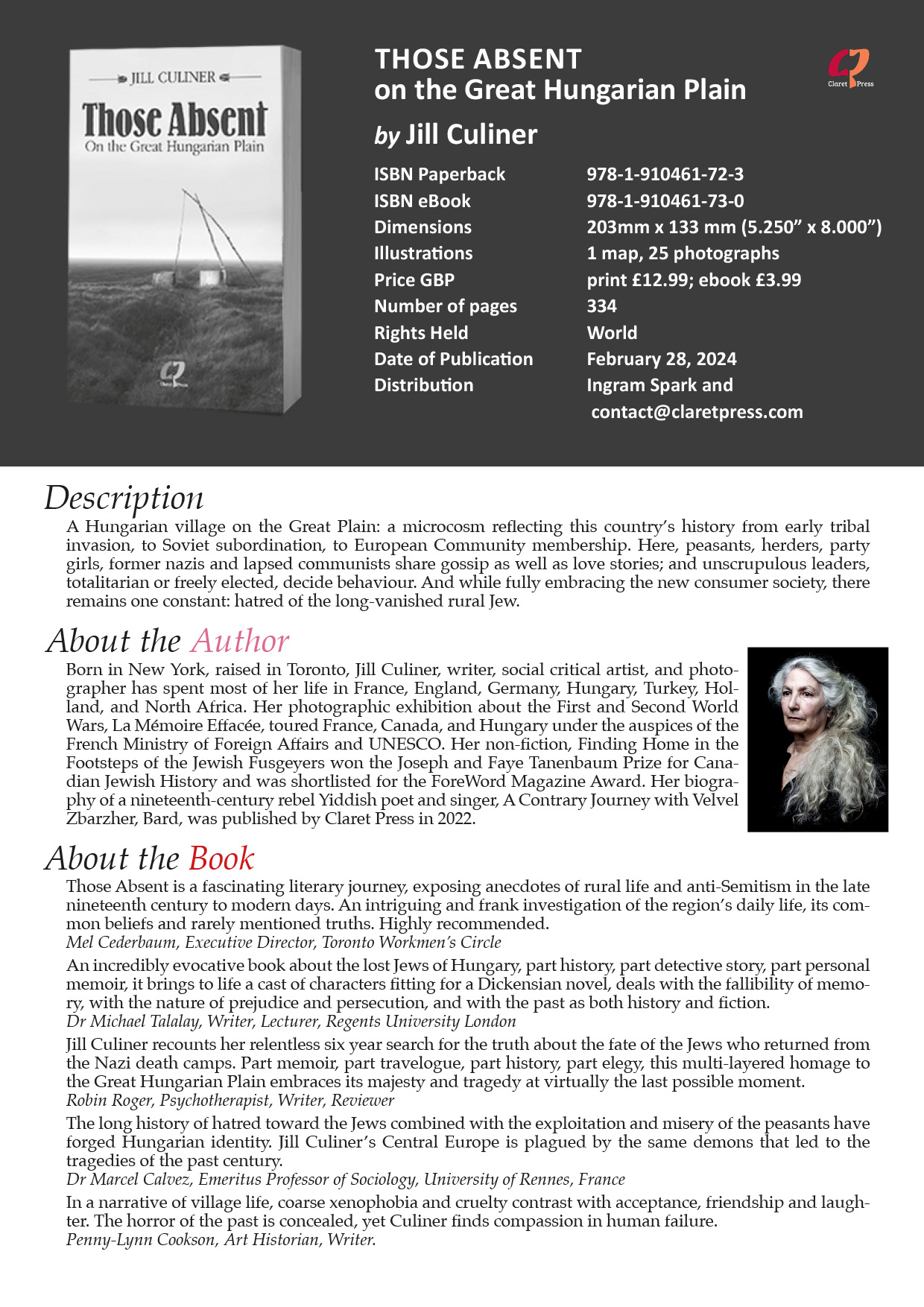
A Hungarian village on the Great Plain: a microcosm reflecting this country’s history from early tribal invasion, to Soviet subordination, to European Community membership. Here, peasants, herders, party girls, former nazis and lapsed communists share gossip as well as love stories; and unscrupulous leaders, totalitarian or freely elected, decide behaviour. And while fully embracing the new consumer society, there remains one constant: hatred of the long-vanished rural Jew.
Author Bio
Born in New York, raised in Toronto, Jill Culiner, writer, social critical artist, and photographer has spent most of her life in France, England, Germany, Hungary, Turkey, Holland, and North Africa. Her photographic exhibition about the First and Second World Wars, La Mémoire Effacée, toured France, Canada, and Hungary under the auspices of the French Ministry of Foreign Affairs and UNESCO. Her non-fiction, Finding Home in the Footsteps of the Jewish Fusgeyers won the Joseph and Faye Tanenbaum Prize for Canadian Jewish History and was shortlisted for the ForeWord Magazine Award. Her biography of a nineteenth-century rebel Yiddish poet and singer, A Contrary Journey with Velvel Zbarzher, Bard, was published by Claret Press in 2022.
She presently lives in a 400-year-old inn in France that is so chaotic and strange, it has been classified as a museum. (http://www.jill-culiner.com)
In 1877, twenty Irish coal miners hanged
for a terrorist conspiracy that never occurred.
BLURB
Anywhere But Schuylkill is the story of one who escaped, Mike Doyle, a teenager trying to find a new home before his alcoholic uncle kills one of his siblings. He takes a job with a union leader, who is also a gangster, while secretly courting his daughter, and quickly learns that the gang leader, cops and rival gang all want him dead.
BOOK INFORMATION
Title: Anywhere but Schuykill
Series: The Great Upheaval Trilogy, Book One
Author: Michael Dunn
Publisher: Historium Press, September, 2023
ASIN: B0CJVW1BP2
Print length: 393 pages
Genres: Historical Fiction, U.S. Historical Fiction, 19th Century
Michael Dunn writes Working-Class Fiction from the Not So Gilded Age. Anywhere But Schuylkill is the first in his Great Upheaval trilogy. A lifelong union activist, he has always been drawn to stories of the past, particularly those of regular working people, struggling to make a better life for themselves and their families.
“There was a time in the history of France when the poor found themselves oppressed to such an extent that forbearance ceased to be a virtue, and hundreds of heads tumbled into the basket. That time may have arrived with us.”
A cooper said this to a crowd of 10,000 workers in St. Louis, Missouri in July, 1877. He was referring to the Paris Commune, which happened just six years prior. Like the Parisian workers, the Saint Louis strikers openly called for the use of arms, not only to defend themselves against the violence of the militias and police who were sent to crush their strike, but for outright revolutionary aims:
“All you have to do is to unite on one idea—that workingmen shall rule this country. What man makes, belongs to him, and the workingmen made this country.”
The Economic Roots of the Great Upheaval of 1877
Run on the Fourth National Bank, New York City, 1873. Public Domain, https://commons.wikimedia.org/w/index.php?curid=517809
The Great Upheaval was the first major worker uprising in the United States. It began in the fourth year of the Long Depression which, in many ways, was worse than the Great Depression of the 1930s. It lasted twenty-three years and included four separate financial panics. In 1873, over 5,000 business failed. Ove one million Americans lost their jobs. In the following two years, another 13,000 businesses failed. Railroad workers’ wages dropped 40-50%. And one thousand infants were dying each week in New York City.
The Long Depression followed a period of rapid wealth accumulation by a few large capitalists, particularly railroad owners. Congress granted them huge swaths of land in 1862. The following year, they passed the National Banking Act, greatly increasing the wealth and power of financial capitalists. In 1864, they placed a 47% tariff on foreign goods, further increasing the wealth of domestic capitalists. They also passed legislation making it easier to import foreign laborers, leading to the largest immigration wave in U.S. history. The lack of regulation and oversight produced large scale greed and corruption. In 1873, Jay Cooke and Company, the largest bank in the U.S., went bankrupt. Cooke’s failure led to a 10-day closure of the New York Stock exchange.
The Great Upheaval Begins
By 1877, workers had suffered four years of wage cuts and layoffs. In July, the B&O Railroad slashed wages by 10%, their second wage cut in eight months. On July 16, 1877, the trainmen of Martinsburg, West Virginia, refused to work. They occupied the rail yards and drove out the police. Local townspeople backed the strikers and came to their defense. The militia tried to run the trains, but the strikers derailed them and guarded the switches with guns. They halted all freight movement, but continued moving mail and passengers, to successfully maintain public support. When militia reinforcements were sent in, most mutinied or refused to fight. Many were former or current rail workers. 70 freight engines and 600 freight cars were soon out of service in the Martinsburg yard, as all divisions of B&O workers walked off the job. The Governor sent in a militia from Wheeling, but they also joined the strike.
The Strike Wave Spreads Along the Rail Lines
Maryland National Guard’s Sixth Regiment fighting its way west along main downtown commercial thoroughfare Baltimore Street through Baltimore, Maryland, July 20, 1877. Public Domain.
News of the Martinsburg victory quickly spread, inspiring other strikes along the B&O. But most of the unions took no action. Some were so heavily infiltrated by spies and Pinkertons that the bosses easily thwarted any actions they did take. Consequently, the strikes were almost entirely spontaneous wildcat actions. And the uprisings quickly spread from New York to Louisiana, and from Baltimore to the west coast. The majority of protests were directed against the bosses and the authorities. But in San Francisco, they turned into an anti-Asian riot.
In the Keyser-Piedmont region of West Virginia, black and white coal miners united to halt a train guarded by fifty U.S. soldiers. They posted a handbill that said: “Let the clashing of arms be heard. In the defense of our families, we shall conquer or we shall die.” In Baltimore, soldiers shot and killed between ten and twenty-two strikers.
Violence in Pennsylvania
In Lebanon, Pennsylvania, a National Guard company mutinied. In Altoona, strikers surrounded the troops and sabotaged the engines, forcing the soldiers to surrender. The soldiers then fraternized with the striking workers and marched home to the accompaniment of singers from an African-American militia company. In Harrisburg, the state capital, teenagers made up a large part of the multi-ethnic crowd.
Burning of Union Depot, Pittsburgh, Pennsylvania, July 21–22, 1877, engraving from Harper’s Weekly. Public Domain.
In Pittsburgh, workers struck against the mighty Pennsylvania Railroad, the largest corporation in the world. Young boys and men from the mills and factories joined in. Again, the militia refused to attack the workers. Many soldiers joined the strikers. So, the Governor brought in the Philadelphia militia. These were battle-hardened soldiers from the Civil and Indian Wars, with no ties to the Pittsburgh community, and no qualms about shooting civilians. They opened fire on the crowd, killing twenty workers in five minutes. The crowd retreated, but returned with their own militia. They burned the rail yards to the ground, holding off firefighters at gunpoint. The Philadelphia militia hid in the roundhouse, but the fire forced them to flee. The workers and police fired on them as they ran. In nearby Allegheny, strikers looted the armory. They dug trenches, took over the telegraph and railroad, and controlled all economic and political functions.
The South
Black longshoremen initiated a strike in Galveston, Texas, demanding a raise to $2.00 per day. Not only were they victorious, but they inspired white workers to join them. In Louisville, Kentucky, black sewer workers initiated a strike wave that quickly included coopers, textile workers, brick makers, cabinet workers and factory workers. Black workers in many parts of the south demanded equal pay to whites.
Chicago
In Chicago, the Workingmen’s Party (affiliated with the First International, in Europe), organized a rally of six thousand people. At this gathering, a former Confederate Army Officer from Waco, Texas, named Albert Parsons, gave a fiery speech. Parsons was radicalized by the events of the Great Upheaval. In the years following it, he became one of the nation’s leading anarchist organizers. He was executed in 1887 as one of the Haymarket Martyrs who had been fighting for the eight-hour workday. His widow, Lucy Parsons, an African American woman, went on to cofound the radical Industrial Workers of the World, in 1905, along with Mother Jones, Eugene Debs, Big Bill Haywood, and others.
The next day, a crowd of young people began moving through the railroad yards, closing down the freights. They went to the factories and stockyards and called out the workers. They shut down the brickyards and lumberyards. That same day, Albert Parsons was fired from his job with the Chicago Times and declared blacklisted.
As in other big cities, the police attacked the protestors in Chicago. One journalist wrote, “The sound of clubs falling on skulls was sickening for the first minute, until one grew accustomed to it. A rioter dropped at every whack, it seemed, for the ground was covered with them.” Police fired into the protest, killing three men. The next day, an armed crowd of 5,000 fought the police, who fired again, killing several more. During the Battle of the Viaduct (July 25, 1877), the police slaughtered thirty workers and injured over one hundred.
The Saint Louis Commune
The most well-organized and lasting uprising of the Great Upheaval occurred in Saint Louis. For nearly a week, workers controlled all functions of society. It was the only town besides Chicago where the actions were predominantly organized by socialists, led by the Workingmen’s Party. The party was organized in four sections, by nationality, to facilitate communication across different languages. Strikers included skilled and unskilled workers. Black and white workers united, even though the unions were all segregated. At one rally, a black steamboat worker asked the crowd if they would stand behind the levee workers, regardless of race. “We will!” they shouted back. Another speaker said, “The people are rising up in their might and declaring they will no longer submit to being oppressed by unproductive capital.”
Women played a prominent role in St. Louis, fighting shoulder to shoulder with the men. According to one news account: “Women with babes in arms joined the enraged female rioters. The streets were fluttering with calico of all shades and shapes. Hundreds were bareheaded, their disheveled locks streaming in the wind. Many were shoeless. Some were young, scarcely women in age, and not at all in appearances. Dresses were tucked up around the waist, revealing large underthings. Open busts were common as a barber’s chair. Brawny, sunburnt arms brandished clubs. Knotty hands held rocks and sticks and wooden blocks. Female yells, shrill as a curfew’s cry, filled the air.” The police clubbed and brutalized the women with the same enthusiasm they used on the men.
The First Uprising Against the Oligarchy
Karl Marx enthusiastically followed events during the Great Strike. He called it “the first uprising against the oligarchy of capital since the Civil War.” He predicted that it would inevitably be suppressed, but might still “be the point of origin for the creation of a serious workers’ party in the United States.”
Ironically, many of the Saint Louis activists were followers of Ferdinand Lasalle, whom Marx detested. And some, like Albert Currlin, a Workingmen’s Party leader in Saint Louis, were outright racists, who mistrusted the black strikers and refused to work with them, contributing to the ultimate failure of the commune.
Labor’s Downfall
Despite the many small victories, the upheaval ended by early August. No social revolution occurred and labor ultimately lost. Federal troops and militias had slaughtered 100 workers and imprisoned thousands more. Most workers did not get a pay raise. And in the aftermath, legislators passed numerous anti-union laws.
However, capital’s victory was not quick, nor easy. 100,000 workers had participated in the strikes. More than half the freight on the nation’s 75,000 miles of track had been halted. The strikers maintained considerable public support. The initial ineffectiveness of the military was due, in part, to the fact that many soldiers had enlisted just to secure a steady income during the depression, only to be forced to work for months without pay. Also, troop levels were relatively small, as many soldiers were still bogged down in battles with the Nez Perce, and with battles against the Indigenous populations of the Rio Grande and New Mexico. Lastly, capitalism itself was relatively young and inexperienced. The bosses weren’t as effective at undermining worker solidarity as they are today. They hadn’t yet mastered how to control public sentiment. But the capitalists did learn a lot from the Great Strike of 1877. In the wake of the uprisings, they constructed many of the old stone armories we see across the country today, in order to provide greater fire power for the next strike wave.
About The Great Upheaval Trilogy
About ten years ago, I set out to write an epic novel about these events. Cleary, there was plenty of excitement for a great work of historical fiction, but far too much for a single novel. So, I decided to write a series, the Great Upheaval Trilogy. And as I did the research, I discovered that just weeks before the Great Upheaval began, twenty innocent Irish miners were hanged in Schuylkill County, Pennsylvania—ten in a single day. It was the second largest mass execution in U.S. history. They were convicted of murder, accused of being terrorists from a secret organization called the Molly Maguires. Dozens were imprisoned. All were union activists. Some held public office, as sheriffs and school board members. And a few of the accused Mollies escaped and were never heard from again.
This became the basis for the first book in the series, Anywhere But Schuylkill, (published by Historium Press, September, 2023), which follows the life of a teenage coal miner, Mike Doyle, one of the Mollies who got away. I am currently working on the sequel, Red Hot Summer in the Big Smoke, which takes place during the train strike in Pittsburgh, and follows the life of Mike’s kid sister, Tara.
Check out other stops on the tour for additional informative essays by the author:
Book Title: Dude or Die
Series: H Double Bar Dude Ranch series
Author: Lynn Downey
Publication Date: October 15, 2023
Publisher: Pronghorn Press
Page Length: 328
Genre: Historical Fiction
BLURB:
It’s 1954, and San Francisco writer Phoebe Kelley is enjoying the success of her first novel, Lady in the Desert. When Phoebe’s sister-in-law asks her to return to Tribulation, Arizona to help run the H Double Bar Dude Ranch, she doesn’t hesitate. There’s competition from a new dude ranch this year, so the H Double Bar puts on a rodeo featuring a trick rider with a mysterious past. When accidents begin to happen around the ranch, Phoebe jumps in to figure out why, and confronts an unexpected foe. And a man from her own past forces her to confront feelings long buried. Dude or Die is the second book in the award-winning H Double Bar Dude Ranch series.
BUY LINK:
This title is available to read on #KindleUnlimited.
Synopsis: It’s 1954, and San Francisco writer Phoebe Kelley returns to the H Double Bar dude ranch in Tribulation, Arizona to help her late husband’s sister Mary, her husband Sam, and their young son Joe run the ranch for the fall season. Phoebe and the ranch were introduced in the first book in this series, Dudes Rush In. There’s stiff competition from a new guest ranch in town, called the Desert Grande, run by a powerful woman named Thelma Powell who seems determined to put other ranches out of business. Phoebe and Mary decide to put on a “dudeo,” a rodeo for both the ranch’s wranglers and the visiting dudes, to thwart Thelma’s efforts. They bring in a trick rider from California with a mysterious past named Eden Williams, and a man from Phoebe’s past also reappears. When accidents happen around the ranch, Phoebe must confront an unexpected foe.
Excerpt from Chapter 20:
Virgil Freeman, a man from Phoebe’s past in Dudes Rush In, is visiting the H Double Bar. They have breakfast the morning after a mysterious midnight fire in a tool shed, and after Phoebe acts on her suspicion that one of the guests is in league with Thelma Powell and the Desert Grande guest ranch.
“How are you this morning?” Virgil asked.
“OK, I guess. I managed to get some sleep, how about you?”
“Oh, I’m fine. Have you seen Mary?”
“Yes, I went over to the site of the fire a few minutes ago, and she is there talking with Sam about rebuilding. She already called her friend at the Bar K and he’s bringing over some tack for today’s trail ride.”
“It’s wonderful the way all the ranches pull together,” said Virgil, who had given his plate to Maryanne and asked for seconds on bacon.
“I know, it’s a very special kind of business,” said Phoebe. “Well, except for the Desert Grande, of course.”
“That place doesn’t sound much like a dude ranch to me.”
“That’s what Mary says. She is sure they are behind some of the mishaps that we’ve had around here.”
“Why would they do that?”
“To put her out of business? Who knows.”
“Have you had any more trouble here from that Carter fellow?”
Phoebe hesitated a moment, then made a decision.
“Well, not exactly trouble, but I did find out something about the both of them.”
She told Virgil about seeing Jayne at the Desert Grande, and about what she found when she searched the Carters’ cabin.
His reaction surprised her. She had never seen Virgil look mad.
“Phoebe, what were you thinking? First of all, that was completely illegal, and what if they came back early and found you? That could have been a disaster for Sam and Mary and their business. And dangerous for you. That Carter guy has a temper, he could have hurt you.”
Phoebe was shocked at his scolding tone, and then she got angry.
“Don’t lecture me, I was very careful, and I can take care of myself.”
“Just because you survived the last time a man threatened you, doesn’t mean it will happen again.”
A guest at the H Double Bar had been killed two years ago, and his murderer pulled a gun on Phoebe when she confronted him. She got away, but had nightmares for a long time.
“I’m worried about you,” Virgil continued.
Phoebe saw a couple of the guests looking their way and lowered her voice.
“Well, you don’t have to be,” Phoebe retorted.
“I know you love Mary and Sam, but does your loyalty to your late husband mean you have to put yourself in danger for them?”
Phoebe gaped at him.
“What the hell are you talking about?”
Maryanne brought Virgil’s bacon at that moment, saw the look on his face, and Phoebe’s, and set the plate down quickly.
When she had scurried away, Phoebe continued.
“First of all, I am not loyal to Jack. He died ten years ago and I’ve moved on with my life. I come here because Mary is like my own sister, and her family is my family. The Desert Grande is a real threat to their business and I will do whatever I can to protect it.”
“You’re being reckless, Phoebe. Please don’t do anything to get yourself hurt.”
“I am not reckless, I know what I’m doing.”
“I don’t think you do.” Virgil stood up. “And it’s obvious I can’t talk you out of any course you plan to take.”
He put his napkin on the table next to the untouched plate.
“I think I should go. Please thank Mary for her hospitality. And please take care of yourself.”
Before Phoebe could respond Virgil left the table and she watched him walk out the lodge door. She sat at the table for a few more minutes, then got up and looked out the front window. Virgil’s car was gone.
AUTHOR BIO:
Lynn Downey is an award-winning novelist, short story writer, historian of the West, and native Californian.
She was the Historian for Levi Strauss & Co. in San Francisco for 25 years. Her adventures as ambassador for company history took her around the world, where she spoke to television audiences, magazine editors, and university students, appeared in numerous documentaries, and on The Oprah Winfrey Show. She wrote many books and articles about the history of the company and the jeans, and her biography, Levi Strauss: The Man Who Gave Blue Jeans to the World, won the Foreword Reviews silver INDIE award.
Lynn got interested in dude ranches during her time at Levi’s. Her debut historical novel, Dudes Rush In, is set on an Arizona dude ranch in the 1950s; Arizona because she’s a desert rat at heart, and the 1950s because the clothes were fabulous.
Dudes Rush In won a Will Rogers Medallion Award, and placed first in Arizona Historical Fiction at the New Mexico-Arizona book awards. The next book in this series, Dude or Die, was released in 2023. And just for fun, Lynn wrote a screenplay based on Dudes Rush In, which is currently making the rounds of reviewers and competitions.
She pens short stories, as well. “The Wind and the Widow” took Honorable Mention in the History Through Fiction story contest, and “Incident at the Circle H” was a Finalist for the Longhorn Prize from Saddlebag Dispatches. The story “Goldie Hawn at the Good Karma Café,” won second place in The LAURA Short Fiction contest from Women Writing the West, and is based on her experiences in a San Francisco religious cult in the 1970s. (That will be another book one of these days.)
Lynn’s latest nonfiction book is American Dude Ranch: A Touch of the Cowboy and the Thrill of the West, a cultural history of the dude ranch. It was reviewed in The Wall Street Journal, True West, Cowgirl, and The Denver Post, and was a Finalist for the Next Generation INDIE Award in Nonfiction. Kirkus Reviews said the book is “…deeply engaging and balances accessible writing style with solid research.”
When she’s not writing, Lynn works as a consulting archivist and historian for museums, libraries, cultural institutions, and businesses. She is the past president of Women Writing the West, a member of the Western Writers of America, and is on numerous boards devoted to archives and historic preservation.
Lynn lives in Sonoma, California, where she sometimes makes wine from the Pinot Noir grapes in her back yard vineyard.
AUTHOR LINKS:
Website: https://www.lynndowney.com [My site is being redesigned and will be live in another week or so.]
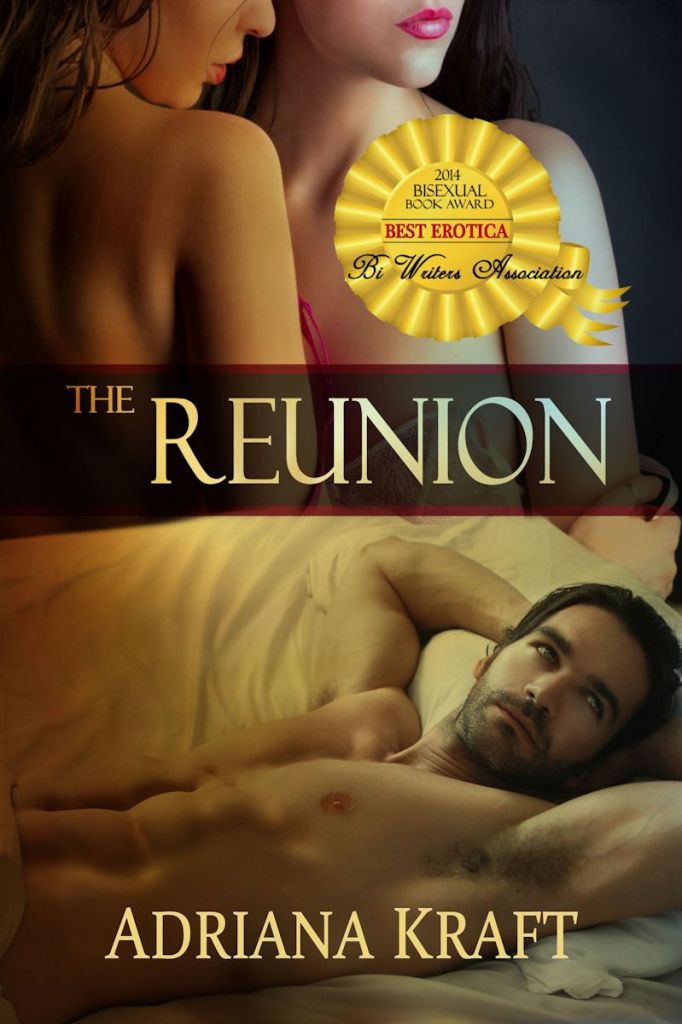
Most of the books Mr. Kraft and I write together are steamy erotic romance, typically (but not always) featuring bisexual women. But that’s not where we got our start. When I started this year-long backlist review in my New Years Day blog post HERE, I noted that we accomplished our first goal – to be a published author – in 2005, with a contract for publication in 2007.
That novel is in our other major genre, romantic suspense, where we typically feature a romance between a man and a woman. In the beginning, we attempted to keep a different pen name for each of the two genres, but this quickly became cumbersome, and we brought all our work together under our “Adriana” name in short order.
The press that first released Willow Smoke in 2007 was sold in 2012, so when we received our rights back, we brought it out under our indie imprint in 2014.
Willow Smoke is actually Book Three in our four-book suspense series set in the horse racing industry, Riders Up, but it was the one we polished first, before the other three were fully fleshed out. Each of the books can be read as a standalone, and they can be read in any order.
WHY WILLOW?
When we lived in northern Minnesota, our forty acres included a small marshy area that grew willow shrubs. Following my mother’s custom, I always cut some branches early each spring and set them in a vase inside to open as pussy willows, usually the first blossoms of the year. My husband dabbled in wood carving while we lived there, and gnarled willow sticks made inviting projects to carve, sand, and stain.
Enter Daisy Matthews, the waif Cassie rescued through her Chicago group home job in Riders Up, Book One. By Book Three, Daisy is tall and lanky and holding her own as an assistant trainer at Chicago’s Arlington Park Racetrack.
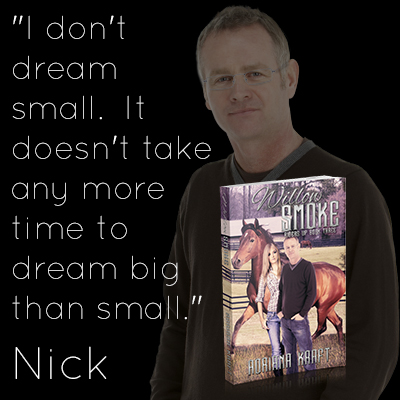
We did not have a title when we began writing this book, but we did know our characters. The much older Nick Underwood has left the stock market, where he made a killing, and he now runs a small company crafting handmade wooden canoes. When he first encounters Daisy in the Arlington Park track barn, he doesn’t know her name, but he’s struck by her smoky eyes and her tall willowy frame. He decides to call her Willow. Our title was born, but we had no idea how important this small shrub genus would become in our story.
As the story gradually made its way onto the page, we sent Nick and Daisy on a canoeing trip to northern Minnesota’s boundary waters, which we so often enjoyed ourselves. On their way home, he stops at a friend’s home (forty acres and a farmhouse, imagine that!). Daisy has often watched Nick working the wood at his shop, and his friend finds an appropriate willow stick and talks her into getting started carving it.
I won’t give away the story’s ending here – I’ll just say that Daisy’s willow stick plays an important role when the chips are down.
REVIEWS
Five stars at Amazon“Adriana Kraft has created memorable characters that linger long after the story has ended and I’ve closed the book. She has done what an author should—brought me into the book’s world and made me care about the characters so that my world will not be the same as before their foray into it.” Sheila G.
Five stars at Goodreads “Suspenseful, intriguing and truly romantic! What a fabulous story of the blending of two worlds… the plot twists and turns and keeps you on the edge of your seat and the pages turning.” Risha C “…dreams can become reality, love can transcend age… Exciting, engaging and very entertaining story. The character interplay is spot on and the story is extremely well written.” Donna H.
BOOK INFORMATION
Willow Smoke (Riders Up, Book Three)
Cover by Rebecca Poole
B&B Publishing, 2014
ISBN: 978-0-9907476-0-4
ASIN: B00N0DH13I
Length: 88,000 words
Genre: Romantic Suspense
Tags: Horse Racing, Age Gap, Sports Romance
Heat rating: three flames (explicit sex, m/f)
BLURB
When the chips are down, there’s nobody there.
Apprentice horse trainer Daisy Matthews grew up on the streets of Chicago, and if she learned anything, it was that she could count on no one to help her, ever. She knows she has to tough it out, protect herself, and when necessary, protect anyone she cares about. All by herself. No one else will do it for her.
Wealthy businessman Nick Underwood receives a thoroughbred in payment for a bad debt and is thrust into Daisy’s world. She teaches him about horse racing; he teaches her about love. When Daisy’s seamy brother-in-law threatens Nick’s safety, she doggedly tries to stop him by herself, but flees to the familiar streets when he attacks. Can Nick find her in time – and if he does, will she still want him?
EXCERPT
Set Up: An interloper has appeared at the stall where Daisy is soaking her horse’s front legs to cool them.
“So tell me,” Nick said, “where can I find a horse named RainbowBlaze?”
“RainbowBlaze!” Daisy gasped and glared at him again. “Why? What do you want with her?”
“Damn, you’ve got to be the most protective woman I’ve ever encountered. If you must know, she’s my horse.”
Daisy opened her mouth as if to speak. She glanced quickly at the chestnut mare. “There must be a mistake,” she stammered. “RainbowBlaze belongs to Michael Barnes.”
Nick crossed his legs and leaned against the stable wall, giving Daisy Matthews a slow satisfied smile. He’d found his horse. And he had a new employee. This could be more interesting than he’d imagined.
Furthermore, being his employee made Matthews safe to be around. He had a firm rule against personal involvements with employees. He flashed a look at the slender woman’s nipples that showed faintly through an orange tank top. Didn’t she know what she looked like?
Too young. He closed his eyes. He might be old enough to be her father. His eyes sprang open and he appraised her again. Maybe, maybe not.
“The horse did belong to Michael Barnes.” Fright flickered across the blonde’s face and quickly disappeared behind a steely gaze. “Mike’s fallen on bad economic times. Turned out he couldn’t pay his debts. Showed up at my office with a bill of sale for some damn race horse and begged me to take it to clear what he owed me. Against my better judgment, I agreed.” Nick raised his open palms upward. “So, here I am.”
Daisy’s hands, resting at her sides, curled into fists.
“You look like you’d like to slaughter me for your supper.” Nick stood. Ignoring the woman, he pointed at the horse with the oversized socks. “So I take it this is RainbowBlaze.” He glanced back over his shoulder at the woman. She gulped and nodded. “Is the horse any good? How much can I get for her?”
Daisy sputtered and Nick suppressed a laugh.
“She’s a damn good mare. She’ll run her heart out for you, if you treat her right. But she won’t work just for anyone.”
“Sounds like you’ve got a thing for my horse, kid.”
“Suppose so.” Daisy studied the dirt at her feet. “I’ve known her since she was foaled. Was there to help her mother give birth. I’ve been there every step of the way when Rainbow was with Cassie Travers, and then when Michael Barnes bought her it was with the understanding that she’d come to Sam’s barn and be with me.”
When the woman stopped to catch her breath, Nick said, “You didn’t answer my question. How much is she worth?”
Daisy shrugged. “Maybe,” her voice quaked, “fifty thousand. Maybe more.”
“Hmm. Michael said a hundred grand.”
He watched the spirit flow out of the young woman. Her glistening eyes grabbed at something inside him that he hadn’t experienced for a long time. Not thinking, he reached for her chin.
“That horse,” he said softly, “means a lot more to you than a hundred grand, doesn’t it?”
BUY LINK
Available exclusively at Amazon and on Kindle Unlimited
For week four, I’m featuring Full Circle, my second submission and acceptance at Extasy Books, published in 2007. You can read more about the story behind Full Circle and its link to the Tarot Three of Cups HERE.
Welcome to Weekend Writing Warriors and Snippet Sunday,
the weekly hop for everyone who loves to write – and read!
Click on the graphics to travel to the other snippets.
EXCERPT
Set Up: As part of their tenth college reunion, exotic dancer Barb (stage name Tammy) has invited her two former roommates to her performance at a private club.
Barb’s two friends had shown up looking just as chic as they had in college. Both had been amazed by her expansive, plush surroundings. Most importantly, they seemed genuinely pleased for her success.
Kneeling near the front of the stage, Barb raised her arms toward the ceiling and smiled broadly, languidly swaying from side to side. Keeping time with the beat of her favorite music, she sat back on her heels and widened her knees. Slowly, she dragged a hand along one inner thigh and then the other, drawing all eyes to the tiny strip of fabric covering her mound. More than one fan smacked their lips together, lost in the web she spun.
She peeked at her former roommates. If she wasn’t mistaken, they, too, were getting caught up in her performance. They’d moved beyond shock. Ruth slumped back in her chair as if she couldn’t quite believe what she was witnessing. Holding Ruth’s hand in her lap, Desiree leaned forward in her seat, making no attempt to conceal her fascination. Desiree’s smile warmed Barb’s entire body. She had waited years for this moment to see that kind of raw lust on Desiree’s face.
BOOK INFORMATION
Title: Full Circle (Three of Cups)
Series: Tarot
Publisher: Extasy Books, 2007
ASIN: B003XREXN2
ISBN: 978-1-55410-804-6
Genre: Erotic Romance
Length: 20,000 words, 80 pages
Heat Level: Five Flames
Explicit sex: M/F, F/F, Ménage: F/F/M, Toys, Anal sex, multiple partners
BLURB
Exotic dancer Barbra Atkins has spent ten years carefully choreographing every step of her meteoric rise to success on the private club circuit. Now it’s payback time for the two college roommates who didn’t have time for their nerdy classmate ~ add three strapping spectacular hunks to the mix, and revenge can be so sweet!
Currently on sale for $2.50 from the publisher.
It’s easy to download Extasy e-books to your Kindle.
“Send to Kindle” instructions are at the top of the Extasy home page.
A red-hot Hawaiian romance blooms for a buttoned-up botanist
who must learn to let go and embrace the ancient voice within her.
Book Information
Book Title: Bound in Roses
Series: Hawaiian Ladies Riding Society
Author: Katherine Kayne
Publication Date: January 23, 2024
Publisher: Passionflower Press
Page Length: 397
Genre: Historical Romance (Gilded Age)
Blurb:
After a failed engagement to a high-society suitor in San Francisco, Lokelani “Lucky” Letwin returns home to Hawaii, leaving her beloved rosebushes behind. She’s desperate to establish a life of her own-a daunting task for any unmarried female in the early twentieth century but particularly for one passionate about the science of plants. A stubborn, song-filled girl now grown into an accomplished woman Lokelani is haunted by a family tragedy. She is as reluctant to acknowledge her past as she is to accept the supernatural force building inside her, strong and inevitable. She is a mākāhā, a Gate, ever connected to the power of the islands . . . if only she will admit it.
In her quest to retrieve her roses, Lokelani is reunited with Artemus Chang, a childhood friend, who’s now a handsome and successful lawyer. As the spark between them grows, Artemus agrees to help her recover her roses, only to discover her kisses leave him literally breathless. When a mystical teacher enters her life, Lokelani’s embrace of the voice of ancient power bubbling up within her takes on new urgency and new apprehensions.
Will Lokelani continue to be bound by guilt and fear? Or will she learn to reconcile her gifts – as both a practical botanist and a mystical Gate – to sing once more and claim her love?
Buy Links:
This title is available to read on #KindleUnlimited.
Award winning author Katherine Kayne writes deeply romantic historical fantasy set in old Hawaii. Her critically acclaimed debut novel BOUND IN FLAME delivers myth, magic and all the sparks promised by the title. The next installment in her Hawaiian Ladies’ Riding Society series, BOUND IN ROSES, is available for preorder now.
Katherine’s novels are filled with horses and history and happily ever after . . . and heroes strong enough to follow their heroine’s lead. She spends a part of each year on Hawaii Island immersing herself in Hawaii’s past. Aided of course by the occasional mai tai. Katherine created the world of the Hawaiian Ladies Riding Society to tell the stories of the fearless horsewomen of the islands’ ranches. Because who doesn’t love a suffragist on horseback? With a bullwhip? Wearing flowers?
If you come along for the ride, be prepared for almost anything to happen. Katherine can promise you fiery kisses, charming cowboys, women who ride like the rainbow to save the day, and that rarest of beasts-handsome men who like to dance.
For week four, I’m featuring Full Circle, my second submission and acceptance at Extasy Books, published in 2007. You can read more about the story behind Full Circle and its link to the Tarot Three of Cups HERE.
Welcome to MFRW Hooks, where the authors of Marketing for Romance Writers share snippets from their stories to entice you into wanting more. Be sure to click on the links at the end to travel!
EXCERPT
PG 13
Barb lost herself in twisting and turning dance movements. Above all else, she loved dancing. On stage she could think. On stage she could be whoever she wanted to be. She stopped to thrust her hips suggestively—stage right, center, stage left and back to center. She knew there were men and women in the crowd pretending to be making love to her as she gyrated before them. She smiled at a redheaded woman in the near corner fondling her own breasts, mimicking Barb’s moves. She often replayed her favorite lovemaking moments while performing, to intensify the experience for everyone. Intense passion—that’s what she was selling. No more. But no less. The audience deserved the best she could create for them.
Barb pulled the thong away from her body and let it snap against her belly. She gave her patrons a startled look of fright and surprise. How many wanted to leap up and protect her?
She peered over at Ruth and Desiree, who still gawked. Barb wanted to purr when she saw that they’d joined hands as if trying to garner strength to comprehend what they were witnessing.
They’d accepted her invitation to join her for their tenth college reunion. Both had gone through recent divorces. While the three of them exchanged Christmas cards every year, Barb hadn’t spoken with either since they’d cleaned out their living quarters right after graduation. Both women, however, had eagerly accepted her invitation to stay with her for the reunion. The campus was a quick twenty miles away. Staying at her house would give them plenty of time to catch up on what had been happening over the past decade.
BOOK INFORMATION
Title: Full Circle (Three of Cups)
Series: Tarot
Publisher: Extasy Books, 2007
ASIN: B003XREXN2
ISBN: 978-1-55410-804-6
Genre: Erotic Romance
Length: 20,000 words, 80 pages
Heat Level: Five Flames
Explicit sex: M/F, F/F, Ménage: F/F/M, Toys, Anal sex, multiple partners
BLURB
Exotic dancer Barbra Atkins has spent ten years carefully choreographing every step of her meteoric rise to success on the private club circuit. Now it’s payback time for the two college roommates who didn’t have time for their nerdy classmate ~ add three strapping spectacular hunks to the mix, and revenge can be so sweet!
Currently on sale for $2.50 from the publisher.
It’s easy to download Extasy e-books to your Kindle. “Send to Kindle” instructions are at the top of the Extasy home page.
In 1828, two young women were torn apart as they were sentenced to transportation to Botany Bay. Will they ever meet again?
Book Information
Book Title: The Low Road
Author: Katharine Quarmby
Publication Date: UK: 22nd June 2023. US: 19th September 2023. Australia/NZ: 2nd January 2024
Publisher: Unbound Publishing
Page Length: 400
Genre: Historical Fiction / Lesbian Fiction / Women’s Literature
Blurb:
Norfolk, 1813. In the quiet Waveney Valley, the body of a woman – Mary Tyrell – is staked through the heart after her death by suicide. She had been under arrest for the suspected murder of her newborn child. Mary leaves behind a young daughter, Hannah, who is later sent away to the Refuge for the Destitute in London, where she will be trained for a life of domestic service.
It is at the Refuge that Hannah meets Annie Simpkins, a fellow resident, and together they forge a friendship that deepens into passionate love. But the strength of this bond is put to the test when the girls are caught stealing from the Refuge’s laundry, and they are sentenced to transportation to Botany Bay, setting them on separate paths that may never cross again.
Drawing on real events, The Low Road is a gripping, atmospheric tale that brings to life the forgotten voices of the past – convicts, servants, the rural poor – as well as a moving evocation of love that blossomed in the face of prejudice and ill fortune.
Excerpt
CHAPTER THIRTY-SIX
We sail into Sydney Cove on a fine autumn May morning. The world turned upside down, right enough. As we near the quay other boats slide alongside, and there are men in them who look us up and down with hunger in their eyes, although they remain silent and the captain looks down at them with venom.
From deck I wonder if I am dreaming to see these miles and miles of sand and wooded shore and then we are in safe harbour. I look out, and find I am clutching at Jennet and Grace.
The streets are uneven, but the houses have gardens and I can see vegetables and fruit growing in them, and chickens and pigs grubbing for food inside wooden pens. I see a quantity of butchered beasts lying outside a great shop and the men with cleavers and bloody aprons. I look away. The houses are made of stone mostly but there are also huts, higher up where the roads run out between the rocks. There are stores too, and women working in the yards. Others gather water from the public well, or shop, or are even bathing. There is order, but also chaos, for “the streets are crooked and unlevel, and the throng immense. Houses perch on the slopes.
We are disembarked and then together we are helped up and onto land. Everything is swaying. We hold onto each other, form a circle of eight as our luggage is heaped up by us. I smell the sea, blood, spices that tickle the nose. London but not London, something else, somewhere else.
The captain comes towards us with papers in his hands. “Jennet will go to the work factory, Grace too. You have farming experience, Hannah?”
“Yes, as a child.”
“Wait here.”
He gestures for everyone to step aside, except me, but for a moment we huddle together and embrace. We promise to find each other, though how will we do it without addresses? But I tell them, desperately, “I will find you, somehow.”
The captain speaks then, seeing our faces. “The newspapers here are full of articles, the names of those assigned often appear in them. It is quite possible to trace somebody, or even place a notice that you are seeking them.” I wonder how we will ever pay for such a thing, but it is a sliver of hope.
Then the captain tells them that they must go to the factory and I feel their arms around me, one last time. We have loved each other on this journey and now Grace and Jennet pick up their bundles, their crates are loaded onto a boat and I watch as they embark and are rowed away, upriver, the vision blurs before me and I cannot see them any more. I am completely alone now.
The captain taps me on the shoulder. “You can milk, you said?” I rub at my eyes with my sleeve. The ground stills at last.
Beside him is a tall man, perhaps in his thirties, brown-skinned and with light blue eyes. He carries a leather hat in one hand, a bag in the other.
“I grew up in service, on a farm in the county of Norfolk.” I hesitate. “I was born on one, sir, in the east of England. I lived on a farm with my mama, until she died when I was still a child. I used to milk the cows and perform other tasks.” Not all of the truth, but enough.
“And could you nurse a little, when I cannot, when I am out, working?” He adds but his voice is jerky, “My wife is ailing.”
“Yes, sir. I nursed my mistress. With my mother, as I was just a child.” The truth again, measured out. I see the farmer’s wife, the spills of opium, and how small her coffin had been, how light. I can bear this.
He turns to the captain, and together they walk over to a table, sign some paperwork and thus I am assigned to work as a servant to Frank Emerson, farmer. I sign my name, and he tells me, “We are sailing to Newcastle, north from here, and then on by river. But first we will eat.”
He leads me through the streets and as I look around me, I wonder how it can be that so much is familiar, and yet I am on the other side of the world.”
Excerpt from
he Low Road
Katharine Quarmby
This material is protected by copyright.
Katharine Quarmby has written non-fiction, short stories and books for children and her debut novel, The Low Road, is published by Unbound in 2023. Her non-fiction works include Scapegoat: Why We Are Failing Disabled People (Portobello Books, 2011) and No Place to Call Home: Inside the Real Lives of Gypsies and Travellers (Oneworld, 2013). She has also written picture books and shorter e-books.
She is an investigative journalist and editor, with particular interests in disability, the environment, race and ethnicity, and the care system. Her reporting has appeared in outlets including the Guardian, The Economist, The Atlantic, The Times of London, the Telegraph, New Statesman and The Spectator. Katharine lives in London.
Katharine also works as an editor for investigative journalism outlets, including Investigative Reporting Denmark and the Bureau of Investigative Journalism.
Three of Cups:
Bounty, abundance, celebration, fruition…all have come full circle
Is it Erotica? Is it Erotic Romance? The next book Mr. Kraft and I published blurs the boundary and is the steamiest book we’ve ever written: Full Circle, published in 2007. Readers born any time after the seventies probably won’t remember a time when the vast majority of popular romance novels kept the bedroom door closed. But with the onset of e-book publishing, indie publishers began to break that barrier, and suddenly there was a rash of new indie e-pubs offering explicit romance.
Full Circle was written in response to a submission call for romance novellas in a Tarot series at Extasy Books. I don’t have any notes about whether we selected our card (which would be appropriate) or whether it was assigned to us – but Three of Cups seemed perfect, and we immediately knew we wanted to write three women. While putting this post together I ran across something I’d written when the book came out:
ménage à six – I don’t speak French, but it just happens that the number six is spelled the same in French and English.
BLURB
Exotic dancer Barbra Atkins has spent ten years carefully choreographing every step of her meteoric rise to success on the private club circuit. Now it’s payback time for the two college roommates who didn’t have time for their nerdy classmate ~ add three strapping spectacular hunks to the mix, and revenge can be so sweet!
EXCERPT
The sheer shock on the faces of her former college roommates proved more satisfying than Barbra Atkins had even dared hope. Tingling, she blew kisses at the rest of her audience, mainly men but with a nice smattering of women present.
Her fans began chanting Tam-my, Tam-my, Tam-my—her stage name. She stretched to her full height, rising on the toes of her high heels, lifting her long curls off her shoulders, knowing full well how that simple gesture accentuated her breasts. Without checking, she knew her nipples had swollen to nearly twice their normal size and jutted against the sheer peignoir top, suggesting a little mystery. Many of her fans didn’t care about mystery. Barb blew another series of kisses and rotated her hips. A little mystery fed the fantasies, bringing her customers back for more, encouraging larger tips, and generating more lap dance opportunities than she could fit in between dance numbers.
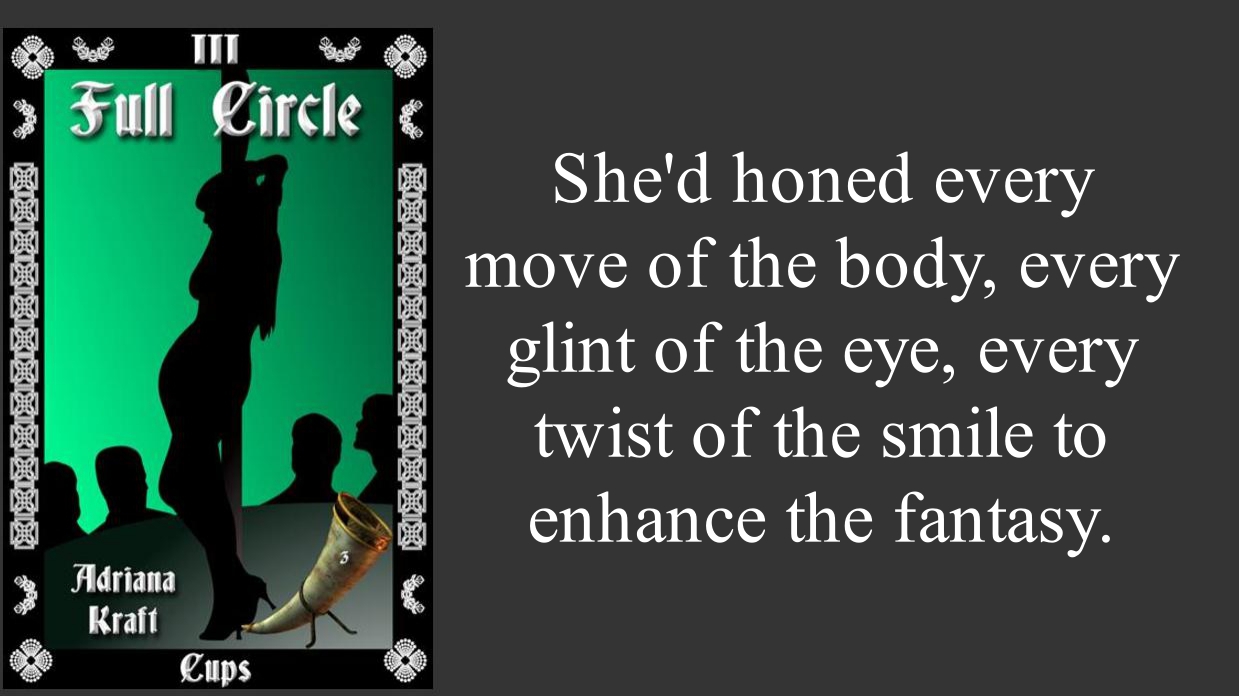
She’d honed every move of the body, every glint of the eye, every twist of the smile to enhance the fantasy. She’d studied hours and hours of tapes of her routines and had rearranged them with a critical eye. Grinning at a beefy man waving a fist full of bills, she danced confidently toward him, knowing that she’d left little if anything to chance.
BOOK INFORMATION
Title: Full Circle (Three of Cups)
Series: Tarot
Publisher: Extasy Books, 2007
ASIN: B003XREXN2
ISBN: 978-1-55410-804-6
Genre: Erotic Romance
Length: 20,000 words, 80 pages
Heat Level: Five Flames
Explicit sex: M/F, F/F, Ménage: F/F/M, Toys, Anal sex, multiple partners
Currently on sale for $2.00 from the publisher.
It’s easy to download Extasy books to your Kindle.
“Send to Kindle” instructions are at the top of the Extasy home page.
For week three, I’m featuring my first submission and acceptance with Extasy Books, published in 2007. You can read more about the story behind The Diary and the choice to set it in Chicago and the U.K. HERE.
Welcome to Weekend Writing Warriors and Snippet Sunday,
the weekly hop for everyone who loves to write – and read!
Click on the graphics to travel to the other snippets.
Set-Up
Set Up: Kate’s younger sister, Luci, has disappeared. When Kate stops by to water Luci’s plants, she discovers Luci’s diary, open on her desk. She reads a snippet, is horrified, and takes it with her, planning to return it later…
EXCERPT
Ten sentences…
Ten minutes later, Luci Parry turned the key in her apartment door and let herself in. She walked quickly to her desk and smirked. Kate had taken the bait. The Diary no longer sat third in the pile of papers on the desk.
Luci sat in her desk chair and drummed her fingers. What would sister Kate make of The Diary? Would she think her half sister was debauched by an older man?
Would she try to find her? Luci chuckled. Kate had seldom been able to find her if she wanted to stay hidden.
And a little more…
She planned to lay low and see what Kate would do with the new insights into her life. If she was true to form, she’d try to identify the man in the diary and somehow hold him accountable.
That was what she’d always done whenever her little sister had encountered trouble. Sister Kate, Luci admitted, had bailed her out of one scrape after another.
Luci entered her bedroom. This time Kate wouldn’t find it so easy to fight her sister’s battles. This time Kate could be introduced to a world that might, that just might break her out of her mother-hen shell.
It was past time. Luci nodded at her reflection in the dresser mirror—way past time. Good grief, Kate had turned forty only two months ago. And what kind of life did she have—work, work, work. And hound her sister.
But Kate’s love life? Zilch! That was wrong—dreadfully wrong. Luci scowled. If it hadn’t been for her parents being killed, Kate would’ve gone on and lived a fairly normal life. Instead, she’d had to take care of a brat who had been too stupid most of the time to show how grateful she’d been.
It was time to make up for the past. And The Diary might yet be the best birthday gift she’d ever given her sister. Too bad she had to be so devious about it. She grinned at her reflection. Who was she kidding? This was about as much fun as she’d had in ages, and Kate would thank her for it someday.
BOOK INFORMATION
Book Title: The Diary
Author: Adriana Kraft
Cover by Martine Jardin
Publisher: Extasy Books, February, 2007
ISBN: 1-55410-765-2
Novel: 70,000 words
Genre: Erotic Romance
Heat Level: Four Flames. Explicit sex: M/F, F/F, Menage: F/F/M, Toys
BLURB
Lust, revenge, dark sexual escapades and the mysterious disappearance of her younger half-sister, Luci, will take art curator Kate Noble on a whirlwind transcontinental journey. The diary Luci’s left behind paints vivid images of shameless erotic exploits with a rake named only as G.C.
Can Kate learn enough under the delightful hands of her bisexual best friend, Gina, to ensnare the sensual and elusive Professor Grayson Cosgrove into a marriage proposal of her making? Can she find Luci before it’s too late? If only she could read between the lines.
The Diary ~ never have the secrets of another been so electrifying!
Currently on sale for $2.50 from the publisher.
It’s easy to download Extasy e-books to your Kindle. “Send to Kindle” instructions are at the top of the Extasy home page.

 BOOK INFORMATION
 Author Bio:


 Synopsis: It’s 1954, and San Francisco writer Phoebe Kelley returns to the H Double Bar dude ranch in Tribulation, Arizona to help her late husband’s sister Mary, her husband Sam, and their young son Joe run the ranch for the fall season. Phoebe and the ranch were introduced in the first book in this series, Dudes Rush In. There’s stiff competition from a new guest ranch in town, called the Desert Grande, run by a powerful woman named Thelma Powell who seems determined to put other ranches out of business. Phoebe and Mary decide to put on a “dudeo,” a rodeo for both the ranch’s wranglers and the visiting dudes, to thwart Thelma’s efforts. They bring in a trick rider from California with a mysterious past named Eden Williams, and a man from Phoebe’s past also reappears. When accidents happen around the ranch, Phoebe must confront an unexpected foe.
 Lynn Downey is an award-winning novelist, short story writer, historian of the West, and native Californian.